
 ErinTaylor
CHECKPOINT OPERATIONS GUIDE • What is automated, what stays human, and which skills matter more in 2026
|
|
|
|
What Is Actually Changing at the Checkpoint?
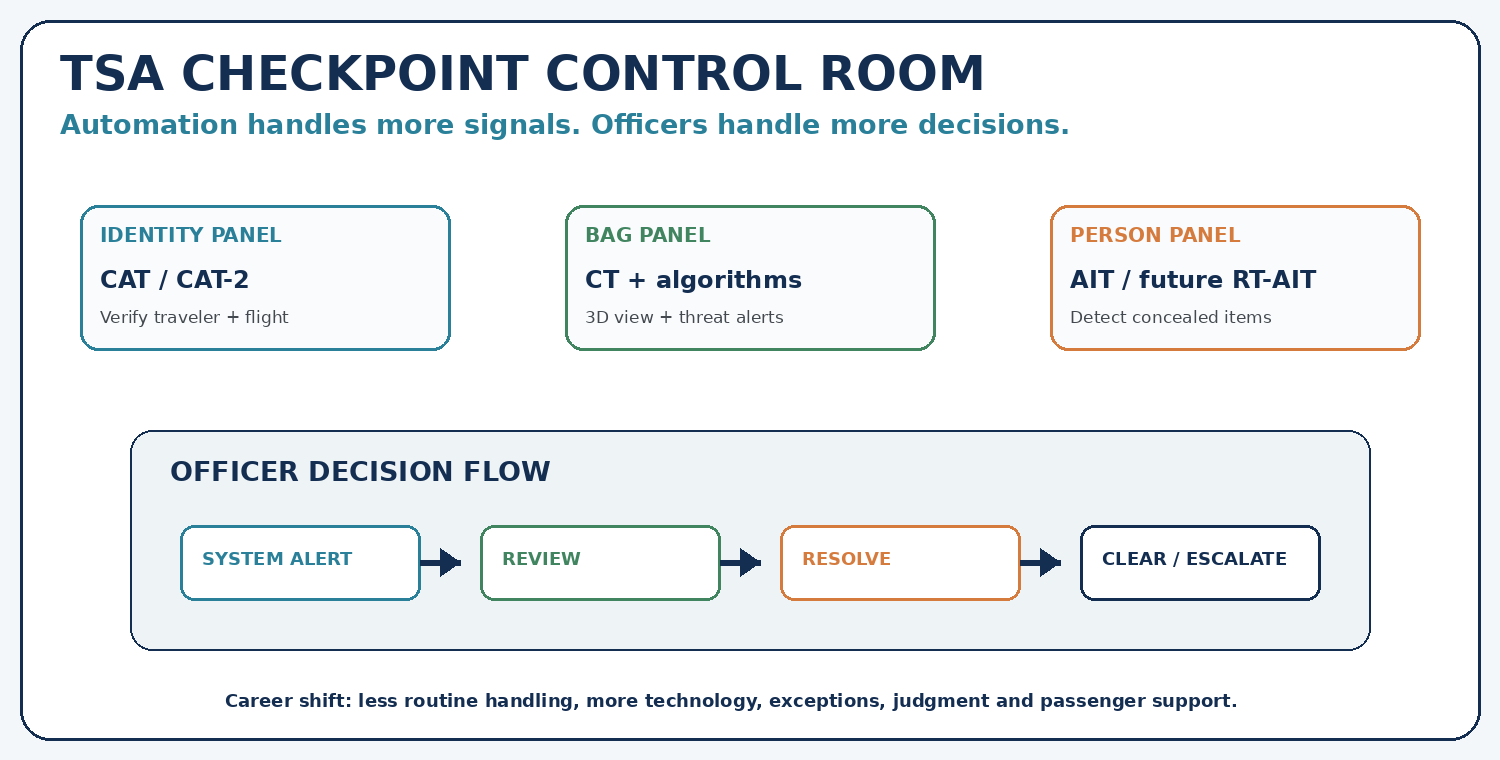
TSA screening is becoming a connected technology system rather than a series of separate manual checks. Identity equipment verifies travelers, CT systems create detailed bag images, detection software highlights possible threats, and officers respond to alarms or exceptions.
The important career point is that automation changes the officer's job more than it removes it. Routine tasks can shrink while technology monitoring, alarm resolution, passenger assistance, and judgment become more important.
People comparing Airport Security Jobs should expect larger airports to place more emphasis on digital screening systems and faster workflow management.
What Is Already in Use
|
|
|
|
|
|
|
|
|
|
|
|
|
|
|
What Is Still Emerging
- More automated target-detection functions inside checkpoint systems.
- Open-architecture screening equipment that allows software updates and new detection capabilities.
- Self-service checkpoint concepts that move routine passenger steps away from direct officer handling.
- Real-Time Advanced Imaging Technology designed to screen people while moving rather than using the current pause-and-pose process.
Emerging does not mean deployed everywhere. TSA technology rolls out by airport, testing status, funding, certification, and equipment availability. Applicants should separate current national practice from pilot programs and future systems.
The Job Is Shifting Toward Four Higher-Value Tasks
1. Alarm Resolution
When software or equipment flags a possible threat, the officer must understand the alert, apply the correct procedure, and decide what additional screening is required.
2. Exception Handling
Technology works best when documents, images, and passenger flow are normal. Officers become especially important when identification fails, a bag needs inspection, or a traveler needs special assistance.
3. Passenger Communication
More automation does not remove the need to explain instructions. In fact, unfamiliar systems often create more passenger questions during early deployment.
4. Technology Adaptation
Officers increasingly need to learn new interfaces, software updates, alarm categories, and fallback procedures when a system is unavailable.
Which Skills Become More Valuable?
|
|
|
|
|
|
|
|
|
|
|
|
|
|
|
|
|
|
Will Technology Reduce TSO Hiring?
Hiring effects will also differ by airport. A major hub with several modernized lanes may need a different mix of officers, leads, trainers, and support staff than a smaller airport using older equipment. Applicants should therefore judge local openings by the actual checkpoint environment rather than assume every TSA location is modernizing at the same pace.
The evidence does not support a simple conclusion that new scanners eliminate TSO jobs. Airports still need officers to supervise lanes, resolve alarms, enforce procedures, respond to unusual situations, and support travelers.
A more realistic change is that staffing needs may shift by checkpoint design. Some routine tasks can be automated, while demand increases for officers who can operate modern systems accurately and move between technology-assisted and manual procedures.
Career Impact Beyond Entry-Level Screening
Modern checkpoints also create a stronger training need. When an airport installs new CT equipment or identity systems, officers need time to learn the interface, understand alarm categories, and practice the fallback procedure used when the technology is unavailable. That gives training staff, lead officers, supervisors, and experienced screeners a larger role in successful deployment.
Another change is performance measurement. Connected equipment produces more operational data about throughput, alarms, lane usage, and system status. Supervisors may use that information to adjust staffing and identify bottlenecks. Frontline employees therefore work in an environment where technology supports both screening and day-to-day operational decisions.
Technology growth also broadens the value of experience in training, equipment support, inspection, testing, program management, and checkpoint operations. A TSO who becomes strong at new systems may be better positioned for specialist or leadership opportunities later.
Current TSA careers include paths beyond standard checkpoint screening, so applicants should look at the wider security and operations system.
What Applicants Should Do Now
- Practice interpreting visual information carefully rather than rushing.
- Get comfortable learning new digital interfaces.
- Follow procedures exactly when an alarm appears.
- Stay calm when technology fails or creates a delay.
- Expect retraining as equipment and software change.
- Build communication skills for passengers who need help with automated screening.
For technical context, DHS's Real-Time Advanced Imaging Technology brief shows how next-generation in-motion screening is being developed and why not every future capability is in routine use today.
Frequently Asked Questions
Is TSA using AI now?
TSA uses advanced detection algorithms and automated functions in several screening systems. Capabilities vary by technology and airport.
Do CT scanners replace bag screeners?
No. They improve the image and software support, while officers remain responsible for alarm resolution and procedures.
What does CAT-2 change?
It automates identity verification and facial matching at equipped checkpoints, leaving officers to monitor and resolve exceptions.
Will self-service screening remove officers?
It may reduce routine handling, but security decisions, alarms, exceptions, and passenger assistance still require trained staff.
What skill should a future TSO build first?
Strong attention, technology comfort, judgment, and clear communication are increasingly useful.
Local training and staffing plans will therefore remain important parts of the transition.
Bottom Line
TSA screening technology is moving toward a smarter, more connected checkpoint. The officer's role is moving with it. Less time may be spent on routine manual steps, while more value sits in alarm resolution, technology use, judgment, and passenger support. Applicants who treat modern screening systems as core job tools will be better prepared for the direction TSA is taking.
